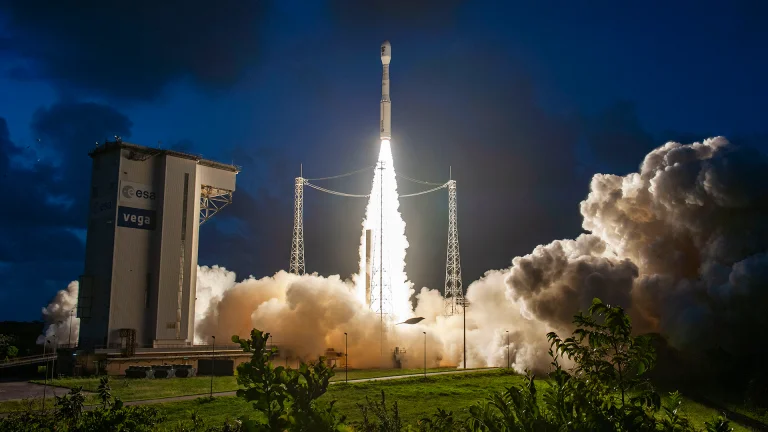
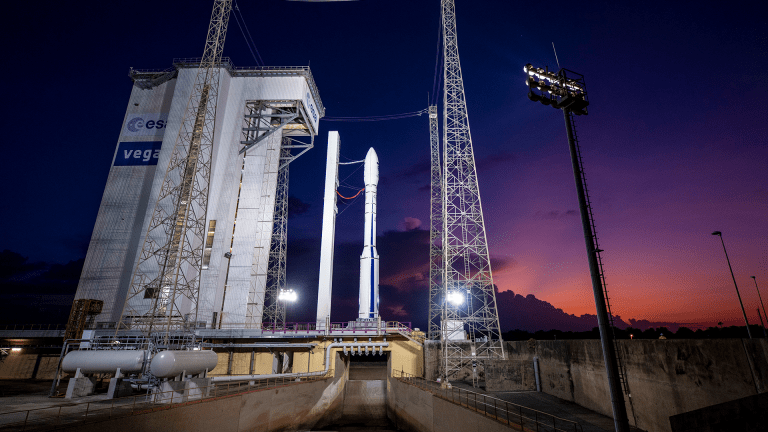
Arianespace’s Legacy:
45 Years of Innovation and Success

To meet the needs and expectations of each of our customers, Arianespace has carried out a wide range of institutional and commercial satellite launches. Since 1980, we have placed more than 1,100 satellites into orbit. A look back at the many missions that have shaped Arianespace’s human and space adventure.

Challenges and Milestones: A Space Story of Continuous Innovation

Since its creation in 1980, Arianespace has placed innovation at the heart of its mission, providing customers with reliable and independent access to space. Relying on powerful and modular launchers, Arianespace has carried out crucial missions serving a better life on Earth, across diverse fields ranging from telecommunications to Earth observation.

Our Latest Milestones

2025

2025

17 December

Ariane 6 Successfully Deploys Two New Galileo Satellites (L14)

Marking its fifth successful flight, the Ariane 6 launcher (A62 configuration) lifted off from Europe’s Spaceport to deliver the SAT 33 and SAT 34 satellites into Medium Earth Orbit (MEO). Reaching an altitude of approximately 22,922 km, the spacecraft were successfully released 3 hours and 55 minutes into the mission. This flight represents Ariane 6’s debut for the Galileo program, bolstering the accuracy and robustness of Europe’s premier navigation system. By executing this complex mission with a specialized upper-stage configuration, Arianespace demonstrates the versatility of its heavy-lift launcher while guaranteeing independent access to space for European Union flagship programs.

2025

04 November

Ariane 6 Successfully Launches Copernicus Sentinel-1D Satellite

The Ariane 6 launcher, in its A62 configuration, lifted off from Europe’s Spaceport and successfully placed the Copernicus Sentinel-1D satellite into a sun-synchronous orbit at 693 km altitude. Separation occurred 34 minutes after liftoff. Built by Thales Alenia Space, Sentinel-1D carries an advanced radar instrument to provide an all-weather, day-and-night supply of imagery of the Earth’s surface, essential for monitoring sea ice, oil spills, and climate indicators. As Ariane 6’s third successful commercial mission, this launch strengthens Europe’s sovereign access to space while ensuring the continuity of the emblematic Copernicus environmental program.

2025

12 August

Ariane 6 Successfully Launches Metop-SGA1 Satellite

The Ariane 6 launcher, in its A62 configuration, lifted off from Europe’s Spaceport and placed the Metop-SGA1 satellite into a sun-synchronous orbit at 800 km altitude. Separation occurred 1 hour and 4 minutes after liftoff. Metop-SGA1 marks the first of a new generation of European polar-orbiting meteorological satellites, carrying six instruments including the Sentinel-5 sensor from the Copernicus program for atmospheric monitoring. As Ariane 6’s second successful commercial mission, this launch strengthens Europe’s sovereign access to space while advancing high-level climate and weather observation capabilities.

2025

25 July

Successful launch of CO3D and MicroCarb satellites (Vega C, VV27)

The Vega C launcher successfully deployed four satellites of the CO3D constellation and the MicroCarb satellite into sun-synchronous orbit from Europe’s Spaceport. The CO3D mission (Constellation Optique 3D) aims to produce a three-dimensional map of Earth’s surface with 50 cm stereo resolution, supporting both civil and defense applications. MicroCarb is dedicated to mapping global sources and sinks of CO₂ using a high-precision spectrometer. By executing this complex mission, Arianespace strengthens Europe’s sovereign access to space and backs Airbus and CNES in their Earth observation goals.

2025

29 April

Successful launch of ESA’s Biomass satellite (Vega C, VV26)

The Vega C launcher successfully placed the Earth Explorer satellite Biomass into a 666 km sun-synchronous orbit. Satellite separation occurred 57 minutes after liftoff.
Executed on behalf of the European Space Agency (ESA), the mission seeks to map global forest biomass using a P-band synthetic aperture radar, capable of penetrating forest canopies to estimate carbon stocks. It will enhance our understanding of forests’ role in the Earth’s carbon cycle.

2025

06 March

Ariane 6’s Successful First Commercial Flight with CSO-3

The Ariane 6 launcher, in its A62 configuration (two boosters), lifted off from Europe’s Spaceport in Kourou at 1:24 p.m. local time for its debut commercial mission, known as VA263. It successfully placed the military observation satellite CSO-3 into a sun-synchronous orbit at about 800 km altitude, with separation occurring 1 hour and 6 minutes after liftoff. CSO-3 completes the CSO (Optical Space Component) constellation within the MUSIS program, delivering high-resolution imaging capabilities to French defense and European partners. This launch marks the start of Ariane 6’s commercial operations, consolidating Europe’s independent access to space.

2024

2024

05 December

Successful launch of Sentinel-1C (Vega C, VV25)

The Vega C launcher successfully placed the Earth observation satellite Sentinel-1C into a 700 km sun-synchronous orbit, under the European Copernicus program on behalf of the European Commission and ESA.
This mission marks the return to flight for Vega C, brings to six the number of Sentinel satellites launched by Arianespace, and strengthens Europe’s commitment to independent access to space.

2024

05 September

Successful Final Flight for Vega (VV24)

The Vega launcher successfully completed its final mission by placing the Sentinel-2C Earth observation satellite into a sun-synchronous orbit at an altitude of 780 km. Conducted as part of the European Copernicus program in partnership with the European Commission and ESA, this mission will provide data for agriculture, water quality monitoring, natural disaster management, and methane emission detection. This was Vega’s last mission. Vega C will fully take over from Vega by the end of 2024.

2024

09 July

First Flight for Ariane 6 (VA262)

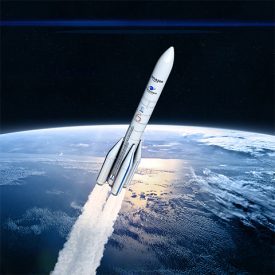
Ariane 6 completed its inaugural launch from Europe’s Spaceport in French Guiana, successfully placing several experimental satellites into orbit. Ariane 6 is a scalable and flexible launcher designed to meet the evolving needs of customers.


2023

July 21

Final Mission for Ariane 5 (VA261)

Ariane 5 made a successful farewell by placing the Heinrich Hertz (Germany) and Syracuse 4B (France) satellites into orbit. This final 33-minute flight marked the end of an era for Ariane 5, Arianespace’s iconic launcher.

April 14

Journey to Jupiter (VA260)

The European Space Agency’s JUICE spacecraft was successfully placed on an escape trajectory, marking the first European mission to the Jovian system. Scheduled to arrive in 2031, JUICE will spend three years studying Jupiter’s icy moons - particularly Europa, Ganymede, and Callisto - to analyze their composition and search for potential signs of life.

2022

July 13

Successful inaugural flight for Vega C

On July 13, at 10:13 am local time at Europe’s Spaceport, in French Guiana, the first Vega C, the new European launcher designed and manufactured by AVIO, was successfully launched under the supervision of ESA. Following the success of its inaugural flight, Vega C will now begin its operational phase, under the responsibility of Arianespace, with a target of at least four launches per year and a fast-growing backlog.

April 05

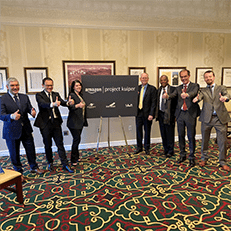
Amazon’s record-setting launch services agreement

Amazon’s record-setting launch services agreement
Ariane 6 will be used in 18 launches for Amazon’s Project Kuiper, performed during a period of three years from Europe’s Spaceport in French Guiana. With this largest launch services contract ever signed by Arianespace, the company will play a significant role in deploying Amazon’s broadband constellation.

2021

December 25

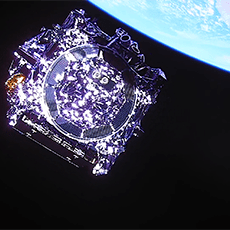
Ariane 5 orbits NASA’s Webb Space Telescope

In one of the most iconic space exploration launches ever performed by Ariane 5, the heavy-lift Arianespace launcher successfully lofts NASA’s Webb Space Telescope – sending the most powerful space observatory ever built on its way to study origins of the Universe. Ariane 5’s very precise injection places Webb on a highly accurate deep-space trajectory, conserving the telescope’s precious on-board propellent for a longer lifetime of discoveries.

September 14

1,000+ spacecraft launched

Arianespace surpasses the 1,000-mark in satellites launched with its 10th mission at the service of OneWeb. Lifting off from Baikonur Cosmodrome on Flight ST35, the medium-lift Soyuz vehicle delivered 34 more spacecraft to orbit for this global operator – bringing Arianespace’s all-time total to 1,021.

2020

September 30

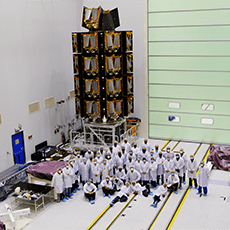
More than 700 spacecraft launched

Arianespace surpasses the 700-mark for spacecraft launched during its four decades of operation. This milestone occurred on the Vega Proof of Concept flight for Arianespace’s innovative Small Spacecraft Mission Service (SSMS), delivering 50-plus nano-satellites and micro-satellites to Sun-synchronous orbits.

2019

April 04

Initial O3b constellation in orbit

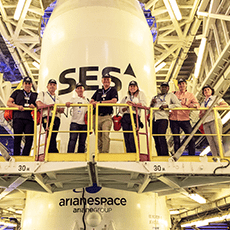
Arianespace completes the first phase of SES’ O3b constellation on a successful Soyuz launch from French Guiana – delivering the 17th, 18th, 19th and 20th satellites into a circular orbit following separate four missions carrying the initial 16 spacecraft.

February 27

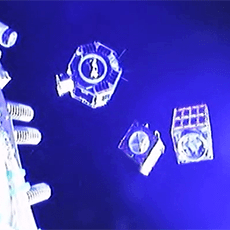
First launch of OneWeb satellites

First launch of OneWeb satellites
Arianespace supported global connectivity with launch of the initial six satellites in OneWeb’s constellation, which was developed to provide affordable high-speed internet access for users around the globe. The cluster of spacecraft was deployed into a circular low Earth orbit on Arianespace’s first Soyuz mission of 2019.

2018

January 09

The final Ariane 5 order

Arianespace and its ArianeGroup parent company announce an order for the final 10 Ariane 5 launch vehicles, representing a total value of more than one billion euros for the European space industry. This order’s size aligns with production of the next-generation Ariane 6 version.

2017

September 14

First Ariane 6 contract

Arianespace receives the first launch contract for its next-generation Ariane 6, covering two future missions that will orbit satellites for Europe’s Galileo constellation using Ariane 62 versions The contract is to be conducted by the European Space Agency (ESA) on behalf of the European Commission and European Union.

June 28

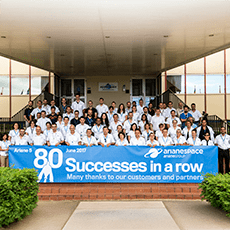
80th consecutive success for Ariane 5

Arianespace’s Flight VA238 marks the 80th successful launch in a row of the heavy-lift Ariane 5. The mission orbits the Hellas Sat 3-Inmarsat S EAN “condosat” – composed of two payloads for operators Hellas Sat and Inmarsat; as well as the GSAT-17 satellite for the Indian Space Research Organization.

June 01

Ariane 5 lift record & first all-electric propulsion satellite

The Ariane 5 heavy-lift launcher sets a new performance record on Flight VA237, carrying a total payload of 10,865 kg. to a geostationary transfer orbit (GTO) and besting its previous record by more than 100 kg. The net liftoff mass for the two satellites lofted was 9,969 kg. The successful launch, the 79th one in a row for the Ariane 5, successfully delivered the ViaSat-2 and EUTELSAT 172B telecommunications satellites to GTO; the EUTELSAT 172B is the first all-electric propulsion satellite to be delivered by an Ariane 5.

2016

November 17

A double Ariane 5 achievement

Flight VA233 marks Ariane 5’s 75th success in a row – surpassing the 74 consecutive launch successes of its Ariane 4 predecessor. The mission also is the heavy-lift vehicle’s first at the service of Europe’s Galileo program, orbiting four of the navigation satellites.

April 19

30 years of success in Japan

30 years of success in Japan
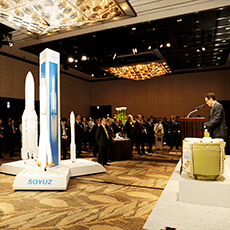
Arianespace celebrates 30 years of partnership with Japanese operators and manufacturers during its annual Japan Week event in Tokyo.

2015

June 25

OneWeb selects Arianespace

OneWeb announces its agreement for Arianespace’s role in deploying the OneWeb Constellation – involving 21 Soyuz launches, plus options for five additional Soyuz missions and three with the next-generation Ariane 6. The first Arianespace launch will take place in late 2017 and the full deployment will be completed by the end of 2019 – supporting the timely deployment for this global connectivity constellation.

June 16

Airbus Safran Launchers

Planned changes in Arianespace’s shareholding structure signal a major step forward in the refoundation of European launcher industry governance: Airbus Safran Launchers (ASL) reaches an agreement with the French State and the French CNES space agency to transfer CNES's stake in Arianespace. After the completion of all regulatory consultation and approval procedures, Airbus Safran Launchers in consequence plans to hold 74 percent of Arianespace's share capital.